03 / 09
The discovery of the bqc·points
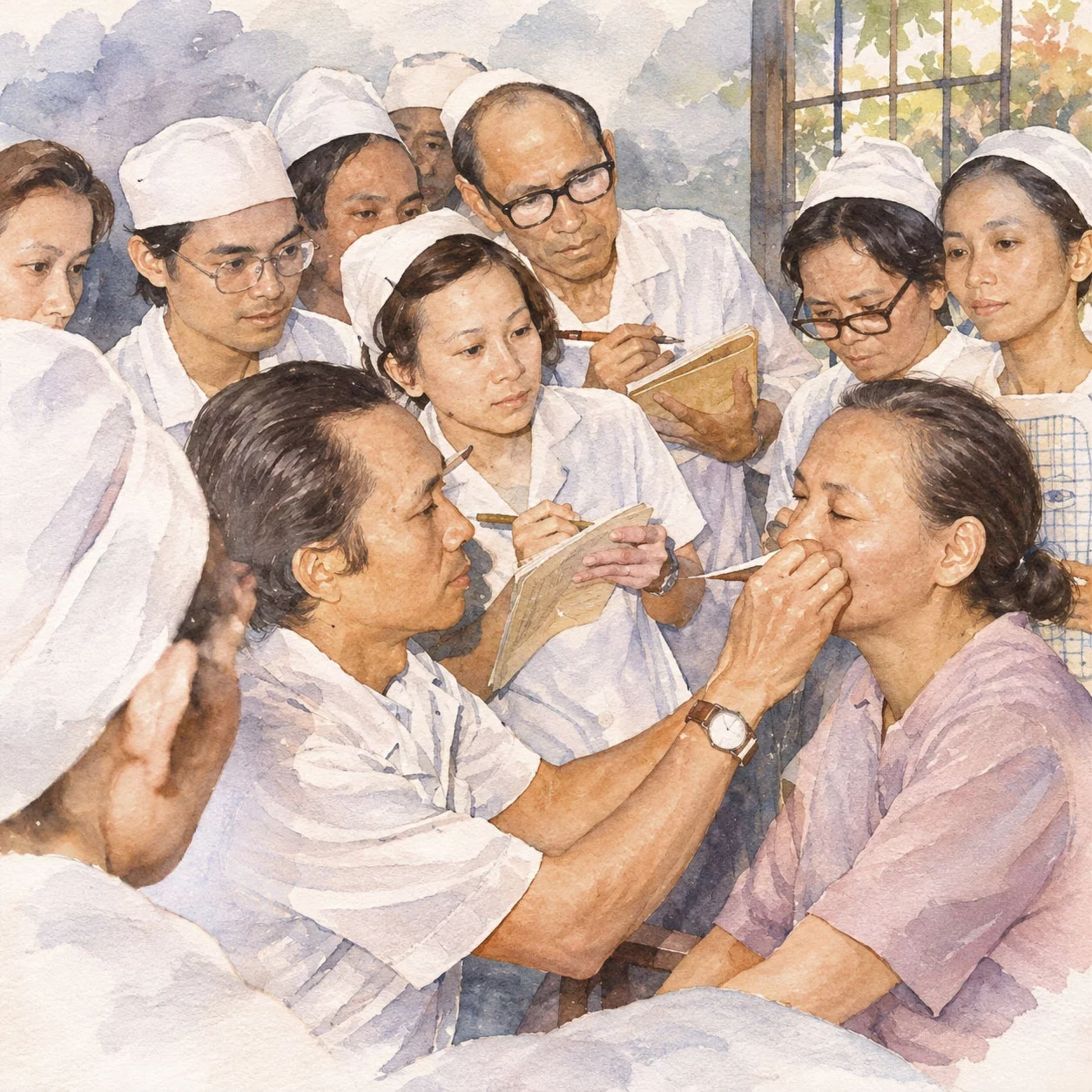
The early 1980s, in Vietnam. Prof Bùi Quôc Châu did not start from any tradition: he observes, notes, cross-checks, verifies.
The bqc·points come from this approach, not from a thousand-year-old heritage.
A modern method, not an ancestral one
Dien Chan has nothing ancestral about it, as it was born in the 1980s in Saigon, at the Binh Trieu centre, from the meticulous observations of Prof Bùi Quôc Châu on the suffering of patients with drug addiction.
To present it as a thousand-year-old heritage is to take away precisely what makes it strong: an empirical construction, verified through repetition and refined through experimentation.
It all starts with an intuition about shape. Looking at a nose in profile, Prof Bùi Quôc Châu is struck by its curve, which resembles that of the human back. He sees in it a representation of the spine and decides to test it. Drawing on the logic of yin and yang from the I-Ching, he understands that the point to look for is at the heart of the sensitive area; that is, the yin in the middle of the yang.
He eventually finds it using microneedles. Although the person feels nothing on the nose, a warmth spreads along their spine. The observation is repeated, confirmed, mapped: this is bqc·point 1·, the very first on the Dien Chan map.
A modern method always begins like this: with an observation that one takes the trouble to verify.
✚ More information:
-
During training, as well as in our booklets and videos, we detail the whole process: how and when Prof Bùi Quôc Châu gave up needles, and how he ended up mapping all his points and establishing the reference lines.
Bqc·points vs living points
The bqc·points make up the Dien Chan map. Located, numbered and validated by Prof Bùi Quôc Châu, they do not move: bqc·point 1· is in the same place on every face, and its field of action is the same for everyone. It is a stable, shareable reference that can be learned.
Living points, on the other hand, belong to one person and one moment only. They are not known in advance: they are discovered with the detector, because they react: a sensitivity, a relief, a change in texture. Tomorrow, they may no longer be there.
The map guides, the face decides. You arrive with the bqc·points, you work with the living points you find. That is exactly what makes Dien Chan a living practice and not the application of a recipe.
What do the bqc·points act on?
A bqc·point always works on two levels at once. Where it is located, it acts on the reflex zone of the face that it occupies. So it is by projecting the reflex diagrams that we understand which part of the body it corresponds to.
A point therefore never does just one thing. That is why we constantly observe the person's reactions and facial expressions: they are what tell us how to adjust the session.
➳ Example:
-
bqc·point 180·, on the temple at the end of the eyebrow ridge, is a good example: it concerns the thumb by reflex and the temple itself by its location. bqc·point 188·, for its part, addresses the nape and the neck, while also influencing the eye area.
-
And if we consult its card, we learn that it also has an effect on cerebral blood microcirculation.